



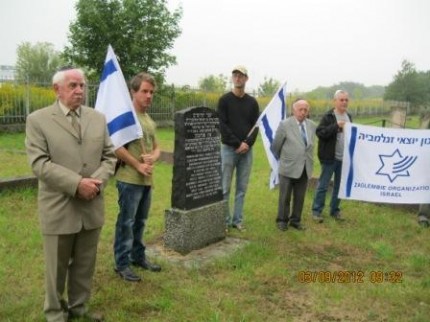
 The organization of Zaglambia veterans was not established out of nowhere. It was preceded by organizations of youths, who immigrated to the Land of Israel from the Zaglambia region over the years and were active there in various organizations.
During the period of the fourth immigration to Israel, between the years 1924-1925, there was a tide of immigration from Poland, during these years hundreds of Jews immigrated to Israel from Galambia. A small number of them are pioneers who settled in kibbutzim and moshavim. Most of them, middle class people, established businesses in Israel. Some succeeded and stayed in Israel, however some had difficulty dealing with the difficult economic situation in Israel and the fever and chose to return to Poland. Most of the returnees perished in the Holocaust.
At that time, when the settlement in Israel was small, the immigrants did not feel the need to establish a separate organization that would unite them. In all the difficulties they encountered, they were helped and supported by the “Poland Expatriate Association” which took care of everyone regardless of city or community.
Despite this, there was an organization of Bandin’s expatriates in Israel. Evidence of this organization is found in the document documenting a meeting that took place in Tel Aviv at the end of Sukkot 1334, 22 Tishrei, October 1, 1934. The document describes a meeting of the temporary committee of the Bandin Expatriate Association with the participation of the members: Shoham, M. Hempel, Reich, S. Lior , Tannenbaum, M.Y. Sancher, Greitzer, Matal and the guest from Bandin, Mr. Avraham Lior.
From the aforementioned document, the following are the goals of the organization that were decided at the meeting:
- To organize the association of Bandin immigrants who are in Tel Aviv and all of Israel to unite in order to continue material and spiritual help to its members and the new immigrants from Bandin.
- to help the Bandinaim immigrate to Eretz Yisrael.
- Submit an ad to newspapers regarding registration.
- To collect one-time amounts for the foundation capital of the association and also to allocate a monthly tax to each and every member.
There is no further documentation on the activities of this group.
In 1939, with the outbreak of World War II and the many refugees from Bandin who fled to Russia, a new organization of a group of friends from Bandin in Israel was formed with the aim of supporting the exiles in the Siberian steppes. The organization was registered with the government offices as a legal association, which allowed it to collect funds and conduct itself publicly in helping refugees from Bandin.
The members of the organization raised donations in Israel and were even helped by the veterans of the organization who were living in the USA and sent packages containing food, clothing and footwear to Benadine refugees in Russia.
In those years, at the same time as the Benadine veterans’ organization, organizations of Sosanovitz and Dombrova veterans were also established.
In 1944, when a “drip” of Holocaust refugees began to arrive in Israel, and the need for help and care for the survivors was felt, and a new committee was elected for the survivors of Bandin that operated out of a shack on Dizengoff Street. The purpose of the committee that was established was to help the refugees in finding work and housing and at the same time to support the survivors of the city who returned to Bandin from the labor
camps One who represents the veterans of the Zaglambia region and thus achieves cooperation, reduction of the mechanisms and efficiency in the activity.
For an unknown reason, the veterans of
Dombrova Gornica decided not to join this union. In order to collect funds for the needs of the survivors, social activities were held: concerts, plays, parties and dances for the hundreds of members who joined the organization over the years
. The ashes were brought to Israel by a survivor who worked near the camp’s furnaces. In the month of Av of the year 1952, a moving ceremony was held, in which the ashes were buried in the Nachalat Yitzhak cemetery. Two years later, a magnificent and impressive monument was erected in memory of all the Jews of Zaglambia who were destroyed in the Holocaust.
Since then, every year there has been a memorial at the site of T’Bav, a date that also symbolizes the final liquidation of the Zaglambia ghettos in 1943.
In 1951, the first commemorative rally for the glorious extinct Jews of Zaglambia was held in the “Ohel Shem” hall in Tel Aviv. The rally was in the presence of the chairman of the Sosanovitz organization, Rabbi Hagar, and the chairman of the Bandin organization, Dr. Rechtman, and hundreds of people present.
Unfortunately, following the death of Rabbi Hagar in 1954, there was a split in the organization and all the organizations returned to operating separately.
On Hanukkah in December 1964, the Bandin organization issued its first bulletin “Yediot Bandin” the editorial members were Mr. Mordechai Hampel and Mr. Aryeh Ben Tov.
In the 1970s, after many discussions, the organization of Zaglambia expatriates was founded in its current form. Initially, the representatives of the cities of Bandin, Sosanovitz and Chaldez, led by friends Ben Tov, Lantzman and Green, joined it. Late All the organizations of Zaglambia joined. The work of reunification was not easy and required patience and patience in finding a common denominator agreed upon by all.
In 1976, the organization received a part of the women’s aid area at 23 Frishman Street in Tel Aviv. . The “tribute” was made possible thanks to the activities of the synagogue worshiper Mr. Menachem Galband from Bandin as well as the synagogue rabbi Rabbi Chaim Pardes, whose family is from Sosnowitz.
In May 1979, the first world conference of the Jews of Zaglambia was held. The conference was held in the Ramat Gan movie theater, which was made available to the organization by its owner Mr. Reuven Wechselman.Delegations from the USA, Canada, Europe and Australia came to the conference.
The discussion at the conference resulted in cooperation among Zaglambian Jews from all over the world.
In the fall of 1980, attorney Aryeh Ben Tov (Hasenberg) brought from Poland 4,714 passport photographs of Bandin Jews, photographs which the Jews were required to give to the Germans in the so-called ghetto in order to receive a work card.
In 1982, in a solemn ceremony, the original photographs were delivered to the Hall of Names at Yad Vashem.
In 1984 The management of the organization decided to plant a forest to commemorate the saints of Zaglambia. The members Greengers, with the help of KKL representatives, worked hard to find an area for this commemoration. An area of 40 dunams was found by them to be suitable for the purpose in the Modi’in area. In the middle of 1985, the “Forest of Zaglambia Saints” was planted in the place, with 10,000 trees.
In 1986, after it was decided to set up a site in this forest to commemorate the Jews of Zaglambia, an international organizing committee was established headed by Mr. Avraham Green, which appealed to artists from Zaglambia to design the site and bring their proposals to it.
A technical committee headed by Mr. Zvi Langer chose from among all the proposals received the project designed by Ms. Marila Feder and Mr. Dov Hov.
To finance the project, the finance committee of the organization (members Greengers, Green, Megar, and Tzim) announced to raise funds among Zaglambian expatriates in Israel and abroad. After the initial sum was collected, the plans were agreed upon with the management of the Jewish Foundation, which also became the executed contractor.
A public committee was established that includes Zaglambian expatriates from all over the world Led by Prof. Yehoshua Perver, Mr. Sam Skora and Dr. Aryeh Ben Tov in order to provide support to the organizing committee.
The hand of remembrance established at the site, which is one of the most impressive and special in Israel, is a source of attraction and interest for many. In 1988, a second world conference for Zaglambia Jewry was held, centered on a solemn and moving Hanukkah ceremony of the Hand of Remembrance for the saints of Zaglambia in Modi’in.
The ceremony was attended by about 2000 expatriates from Zaglambia, among them over 200 guests from different countries. A reunion rally was held for the Jews of Zaglambia in the presence of public figures and a large crowd.
In 1993, a delegation of the organization, Ben Tov, Skora, Feder and Green, met with mayors in the Zaglambia region and agreed with them on the commemoration of the Jewish sites in the towns. Already in the same year, a monument was inaugurated in Bandin on the site where the burned down synagogue stood.
The organization maintains contact with mayors in their area of residence in Poland and sends delegations to visit the place and the cemeteries in the Zaglambia area.
In 1994, an agreement was made, valid for 50 years, with KKL-Junk, which assumed responsibility for maintaining the Hand of Remembrance and assistance in holding the annual rally on Holocaust Day.
From 1997, the publication of the “Zaglambia Bulletin” began, the purpose of which is to preserve the connection between the members of the organization in Israel and members abroad “to. The leaflet is published in preparation for the Tishrei and Passover holidays.
Goals of the organization
As of December 31, 1997, the “Organization of Expatriates of Zaglambia Communities in Poland” was approved as an association legally registered in Israel and annually submits a report to the Registrar of Associations.
The organization has approximately 1,500 registered members, which include members of the first, second and third generation of Zaglambia Jews.
The organization operates in the fields Many are engaged in perpetuating the past, preserving the connection and succeeding in harnessing the second and third generation to the extensive and ongoing activities in Israel and abroad.
The organization encourages reciprocal visits between Zaglambia people in Israel and around the world, maintains continuous and active contact with its branches in the USA, Canada, Australia, France, Germany, etc.
Below are the activities the organization engages in :
Commemoration
The organization commemorates and considers it an obligation to continue perpetuating the memory of Zeglambia Jewry and passing on its legacy to future generations both in Israel and abroad.
This activity includes:
1. The cemetery of Nachalat Yitzchak – a tombstone was erected and ashes brought from Auschwitz and Zeglambia were buried under it. This tombstone was the first memorial site in the region Tel Aviv, where a memorial ceremony is held every year.
on. The commemorative site of the Zeglambia Saints Forest in the heart of the Ben Shemen Forest, near Modi’in. The place is Gilead in memory of the magnificent Zaglambia Jewish communities that were destroyed in the Holocaust.
The site is very impressive and includes:
- A memorial hand to commemorate the victims and the “Remember” monument, which is visible in the distance. Next to it are six beacons in memory of the victims of the Holocaust and a seventh beacon for the glory of the State of Israel.
- A broadside with the names of the sword communities and an explanation of them.
- A basement for the commemoration of the fallen – on its walls are engraved the names of thousands of martyrs who were murdered.
- 10,000 trees planted in memory of the victims. An open theater amphitheatre, used for memorial ceremonies, gatherings and events, was built between the trees.
- A hand in memory of the martyrs of “The Last Son” – the martyrs of Israel’s systems, who were saved from the inferno, but were killed by Israel’s systems and whose family has no trace left.
- A monument to the memory of four girls from Glambia, who were hanged in Auschwitz due to their help to the Sonderkommando rebels in Auschwitz in 1944.
- A monument commemorating the last letter from Bandin – written on July 13, 1943 by members of the next day, signed by representatives of the youth movements and sent by a special envoy to Israel. Every year, on the day of the Holocaust, a ceremony is held there, with many participants of Zaglambia veterans, including the second and third generation. Public figures and guests from Israel and abroad also take part in it.
third.
Commemorating the memory of Zaglambia Jewry in Poland – we are working to have the cemeteries in the Zaglambia region renovated and maintained and to erect monuments at sites that were ghettos. Based on the connections we made with the authorities in Zegalambia, we are making sure that wall panels will be placed in places where there were central Jewish institutions such as synagogues, schools, hospitals, etc.
d. Once in a while, delegations of Zaglambia expatriates and their families go to towns in Poland , to visit and commemorate the Jewish tradition.
the.
Contact with entities and private individuals working for the preservation of Jewish heritage in various sites and places such as Brama Cukermana, Cafe Jerusalem (Cafe Jerozolima) in Bandin.
Publications and Information Bulletin
Twice a year, the organization publishes a newspaper with information on activities that took place during the period, on what is happening among the people of Zaglambia in Israel and around the world, useful information as well as personal stories of Holocaust survivors.
In addition, we make every effort to convey information to our fellow Holocaust survivors regarding the exercise of their rights and how they should act to receive them.
Website www.zaglembie.org
The organization has a website, which serves as an inexhaustible resource. The organization’s website is currently in the process of being upgraded. Part of the site has been translated and is accessible to English speakers. The site has also been adapted for smart phones.
Selected parts of the website have also been translated into the Polish language.
Gatherings and Events
The organization holds four events every year: a Hanukkah party, a Tu of Shabbat ceremony and a toast on two holiday eves: Rosh Hashanah and Passover..
These gatherings create an intergenerational connection, a shared identity is created that brings people to want to preserve togetherness, to feel like a big family.
A. Hanukkah party – since the 1960s, we have been gathering on one of the evenings of the holiday, lighting candles and enjoying a fun social gathering –
a gathering of the members of the organization and their families in the Boach Modiin forest. In recent years we have been trying to involve almost all generations in the activity, however we emphasize that this meeting will especially activate and integrate the members of the third generation.
third. Rosh Hashanah and Passover – Twice a year a traditional meeting is held that combines a social gathering, a toast in honor of the holiday and the inclusion of members in information about the organization’s activities during the year and future plans.
d. Lectures on the subject of the Holocaust and its commemoration for future generations – are held in our club once in a while (Cafe Zaglambia).